



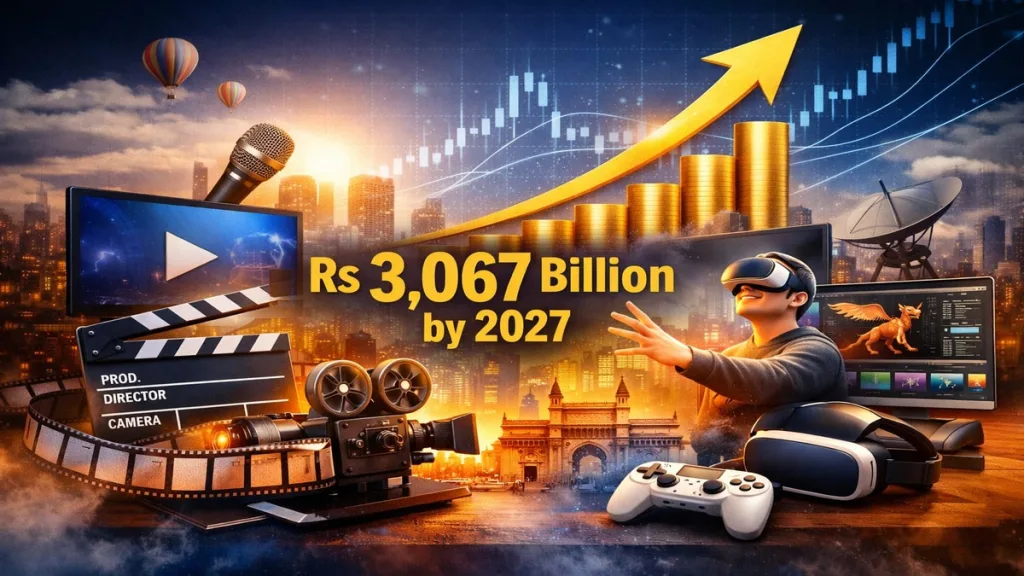
India’s entertainment industry has always known how to put on a show. But in 2026, the scale, speed, and sheer variety of that show have reached a level few could have predicted even five years ago. With streaming platforms fighting for eyeballs, regional cinema stealing the spotlight from Bollywood, and gaming turning into a mainstream pastime, the industry is projected to cross a staggering ₹3 lakh crore in value this year — and the way over 1.4 billion people watch, listen, and play is being rewritten in real time.
Streaming Wars, Round Two
If the first wave of India’s streaming boom was about simply getting people online, the second wave — the one playing out now — is about keeping them there. Netflix, Amazon Prime Video, Disney+ Hotstar, JioCinema, and SonyLIV are all pouring money into original, India-specific content rather than relying on dubbed international shows to carry the load. The competitive pressure has pushed platforms toward hybrid business models: free, ad-supported tiers sitting alongside premium subscriptions, a strategy designed to capture both price-sensitive users in smaller towns and willing-to-pay urban audiences.
This isn’t happening in a vacuum. Massive smartphone penetration and increasingly affordable mobile data have turned streaming from an urban, English-speaking phenomenon into something genuinely nationwide. Viewers in tier-2 and tier-3 cities are now just as likely to be binge-watching a regional drama as someone in Mumbai or Delhi — and platforms are chasing that audience aggressively with content in local languages.
Bollywood Adjusts, Regional Cinema Rises
Hindi cinema is having to rethink its playbook. The era of assuming a big-budget, star-studded release automatically guarantees box office success is fading. Instead, 2026 is seeing a genuine comeback for mid-budget, content-driven films — stories that lean on strong writing and performances rather than spectacle alone. There’s also a noticeable shift toward women-centric narratives and socially relevant storytelling, reflecting audiences who increasingly want to see their own lives and concerns reflected on screen.
Meanwhile, South Indian cinema — spanning Tollywood, Kollywood, and Mollywood — continues to punch above its weight, regularly topping the pan-India box office charts. The “pan-India film,” a movie released simultaneously across multiple languages to capture audiences nationwide, has gone from a rare experiment to a standard strategy. Big-budget regional productions are no longer regional in ambition; they’re engineered from the ground up to travel across state and language lines, competing directly with — and often beating — traditional Hindi-language blockbusters.
Music and Gaming Join the Mainstream
India’s music industry is riding its own wave of growth, with platforms like Spotify, JioSaavn, and YouTube Music competing to become the default soundtrack for the country’s daily commutes and workouts. Independent and regional-language music is finding audiences far beyond its home turf, helped along by algorithmic playlists that surface niche artists to listeners who might never have discovered them otherwise.
Gaming, once dismissed in India as a niche hobby, has firmly entered the mainstream. Rising smartphone quality, better internet speeds, and a young, digitally native population have combined to make mobile gaming a genuine cultural force — one that increasingly overlaps with entertainment more broadly, as gaming influencers, esports tournaments, and in-game events pull in audiences that rival traditional TV viewership.
Technology Is Changing How Stories Reach Audiences
Behind the scenes, artificial intelligence is quietly reshaping how entertainment gets made and delivered. Streaming platforms are investing in smarter recommendation engines that account for regional preferences and language choices, aiming to make content discovery feel personal rather than generic. On the news and media side, a similar trend is playing out: growing investment in regional and vernacular content, alongside AI-assisted personalization, is helping publishers hold on to audiences in an increasingly fragmented attention economy.
Why It All Adds Up
What ties these threads together — streaming, cinema, music, and gaming — is a broader story about India’s entertainment industry finally building for India, rather than adapting foreign formats and hoping they stick. The country’s linguistic diversity, long treated as a distribution headache, is increasingly seen as a competitive advantage: an industry that can tell stories in dozens of languages and still find scale has a durability that more homogenous markets simply can’t match.
There are still challenges ahead — profitability pressures on streaming platforms, piracy, and the difficulty of monetizing a price-sensitive audience chief among them. But the underlying momentum is hard to ignore. With smartphone penetration still climbing, regional content proving it can go national, and technology making personalization sharper than ever, India’s entertainment industry isn’t just growing — it’s fundamentally changing shape, and 2026 looks like the year that shift became impossible to overlook.